What to Write About When You Have No Travel Blog Ideas
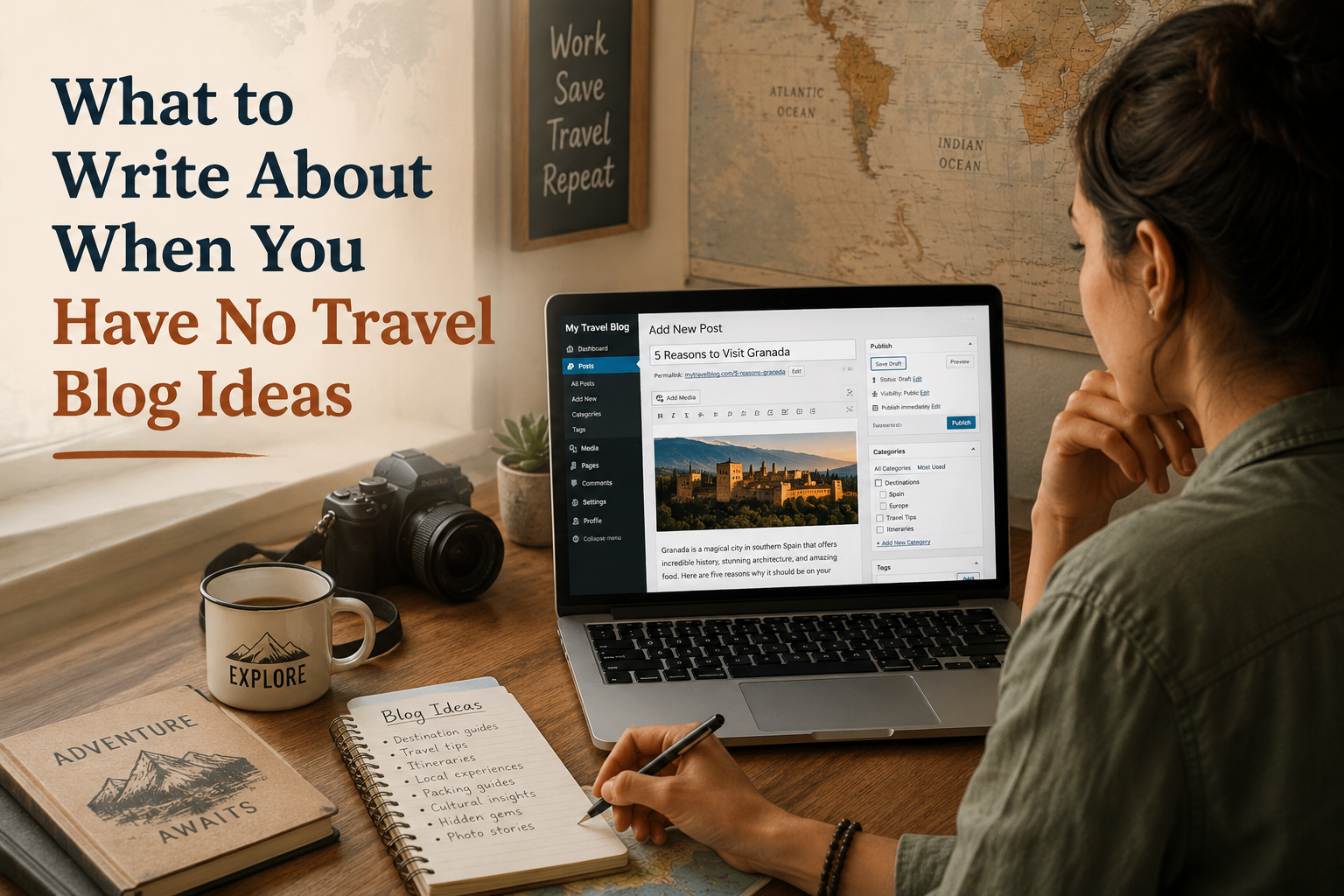
You know you need to blog. You've known for two years. You open a new WordPress post, stare at the blank title field, and close the tab. This is not a writing problem — it's a framing problem. You're trying to think of something to write when your destination, your guests, and your own operations are handing you 50 topics a month.
Here's the full list — organised by type, with enough context to get the first draft moving.
Why Tour Operators Run Out of Blog Ideas (The Real Reason)
Most operators approach blogging like a journalist looking for a story — waiting for something interesting to happen, then writing about it. That's the wrong model. Your blog isn't a news feed. It's a library of answers to questions your ideal guests are already typing into Google.
When you reframe it that way, the blank page disappears. You're not inventing content. You're documenting what you already know.
The uncomfortable truth: operators who "have no ideas" usually have the most to write about. They run tours every week. They answer the same guest questions before every departure. They know which villages are worth stopping at and which aren't. That's not just experience — it's content. It just hasn't been written down yet.
Destination Guide Posts (Your Highest-Traffic Content Type)
Destination guides are the backbone of any tour operator blog and consistently the highest-traffic pages on well-run tourism sites. Every place you operate in is a candidate.
The classic day trip guide: "How to Spend a Day in [Destination]" — written for the independent traveller who might book your tour once they've read it
The practical companion: "Getting to [Destination] from [Departure City]: All Your Options" — covers transport, timing, and naturally positions your private tour as the premium choice
The insider angle: "What Most Visitors Miss in [Destination]" — this is where your 12 years of guiding actually shows up on the page
Seasonal versions: "[Destination] in Winter", "[Destination] in May" — travellers search by season constantly, and these pages rank with surprisingly little competition
Neighbourhood or area breakdowns: "The Old Town vs the New Quarter: Where to Spend Your Time in [City]" — works especially well for cities like Seville, Granada, or Lisbon where visitors need orientation
A private day tour operator running Ronda trips from Marbella could write a different Ronda guide every quarter — the geology of the gorge, the best restaurants near the bridge, the Hemingway connection, what to do if it rains — and each one captures a different search intent.
Comparison and Decision Posts (What Converts Best)
Travellers who are comparison-shopping are close to booking. Content that helps them decide — honestly, without hard-selling — converts at a significantly higher rate than generic destination posts.
"Private Tour vs Coach Tour: What's the Difference in [Destination]?"
"Renting a Car vs Booking a Private Tour from [City]: Which Makes More Sense?"
"[Destination A] vs [Destination B]: Which Day Trip Is Right for You?"
"Half-Day vs Full-Day Tour to [Destination]: What You Can Realistically See"
"Is [Destination] Worth a Day Trip? An Honest Answer"
These posts work because they're genuinely useful — not promotional fluff — and they attract readers who are already in buying mode. Write them as if you're giving honest advice to a friend. That's what makes them rank and convert.
FAQ and Practical Information Posts
Every question a guest has emailed you before a tour is a blog post waiting to be written. These are also the posts most likely to appear in Google's AI Overviews and get cited by tools like ChatGPT — because they answer specific questions directly.
"What to Wear on a [Destination] Day Trip in Summer"
"How Early Should You Book a Private Tour in [Region] During High Season?"
"Can You Visit [Destination] with Young Children? What to Expect"
"Is [Attraction] Worth the Queue? An Honest Review"
"How Much Does a Private Day Tour from [City] Cost? A Realistic Breakdown"
"[Destination] in One Day: Is It Enough Time?"
At CostaExcursions.es, some of the highest-converting pages are exactly this type — practical, specific answers to questions guests were asking anyway. The content takes an afternoon to write once. It answers the same question 10,000 times a year.
Itinerary and "Best Of" Posts
Itinerary posts are popular with travellers in the early planning stage — before they've committed to specific tours but while they're imagining the trip. Showing up at that point builds familiarity before they ever reach a booking page.
"The Perfect 3-Day Itinerary in [Region] for First-Time Visitors"
"Best Day Trips from [City]: Ranked by Distance and What You Get"
"One Week in Andalusia: How to Structure It Without a Car"
"The Best Things to Do in [Destination] on a Cruise Port Day"
"[Region] for Couples: What to Prioritise and What to Skip"
These posts tend to attract backlinks naturally — travel bloggers, tourism aggregators, and local sites all link to good itinerary content. Over time, that means authority and rankings without additional effort.
The list above is a content plan — but a content plan only works if someone executes it. Most operators read a post like this, get a burst of motivation, write one article, and then ops takes over again. BlogDone handles the research, writing, and publishing month after month, so the plan actually gets done. We've built this system for our own tour site (CostaExcursions.es) and we run it for independent operators across Spain and the Mediterranean. See how BlogDone works — or request a free sample post written specifically for your destination.
Behind-the-Scenes and Experience Posts
Travellers booking a premium private tour want to know who they're booking with. Content that humanises your operation builds trust in a way that a booking page never can.
"What a Typical Private Tour Day Looks Like with [Company Name]"
"Why We Always Stop at [Specific Place] on Our Ronda Tours"
"The Story Behind Our [Signature Tour] — How It Started and What's Changed"
"What Our Guests Ask Most (And Our Honest Answers)"
"How We Choose Restaurants on Our Tours: The Criteria We Actually Use"
These posts won't necessarily top the Google rankings — but they do something else. When a guest has been comparing five operators and lands on a post like this, the decision often gets made right there. You've shown them who they'd be spending the day with.
Seasonal and Event Posts
Seasonal content captures high-intent searches during the planning window before major travel periods. Write it six to eight weeks before the season hits — Google needs time to index and rank it.
"The Best Time to Visit [Destination]: Month-by-Month Guide"
"[Destination] in Easter Week: What's On and What to Expect"
"Avoiding the Crowds in [Popular Destination]: When to Go and When Not To"
"[Destination] in Spring: Why It's Our Favourite Time to Run Tours There"

Frequently Asked Questions
How often should a tour operator publish new blog posts?
Once or twice a month is enough to build meaningful search visibility over 12 months. Consistency matters more than frequency — a site that publishes two solid posts per month for a year will significantly outperform one that publishes ten posts in January and nothing after. Starting with your highest-priority destinations and working outward gives the best return on early effort.
What length should a tour operator blog post be?
For destination guides and comparison posts, 1,200–1,800 words is the practical range — long enough to cover the topic thoroughly, short enough to keep it readable. FAQ posts and "what to wear" style posts can be shorter at 800–1,000 words. The goal is to fully answer the question the post is targeting, not to hit a word count for its own sake.
Should a tour operator blog about destinations they don't operate in?
Generally, no — unless the content serves your existing customers (e.g. a "what else to see while you're in the region" post). Writing about unrelated destinations can dilute your site's topical authority and attract visitors who will never convert. Focus your content on destinations you operate in or nearby alternatives your guests regularly ask about.
Can a tour operator use AI to write their blog?
AI tools can generate a draft quickly, but the output tends to be generic — the same descriptions of the same landmarks that every other tourism site already has. What Google and AI search tools increasingly reward is specificity: the detail only someone who has run that tour 200 times would know. AI works best as a drafting aid with a knowledgeable operator editing the result, or as part of a done-for-you service that combines AI efficiency with destination expertise.
Which blog post type drives the most direct bookings for tour operators?
Comparison posts and decision-stage content tend to convert at the highest rate because they attract readers who are already close to booking — they're choosing between options, not just researching. "Private tour vs self-drive", "is X worth a day trip", and pricing breakdown posts regularly outperform pure destination guides on direct conversion, even if the destination guides bring in more total traffic.