How Tour Operators and Small Hotels Can Get Recommended by ChatGPT and Gemini
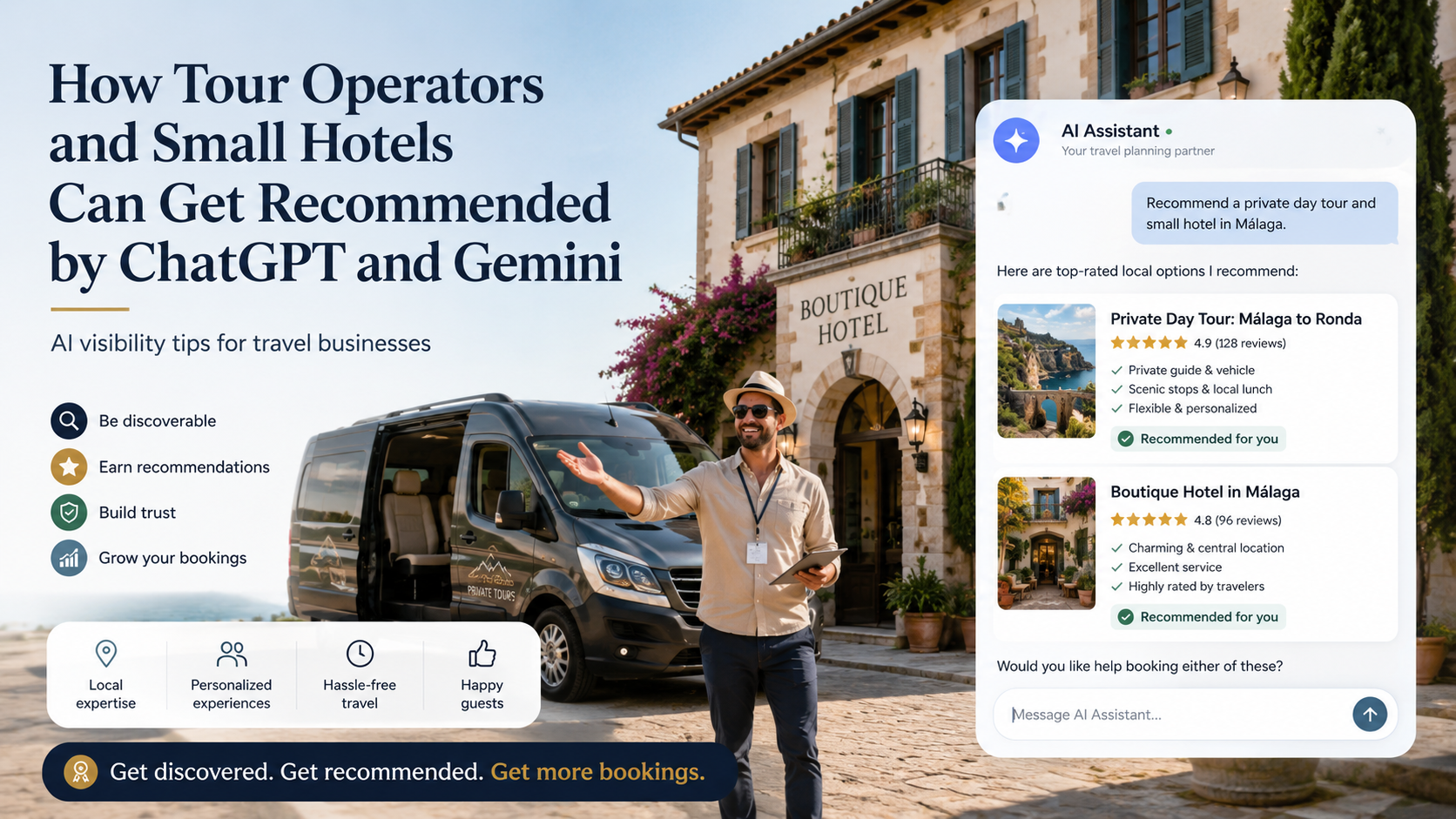
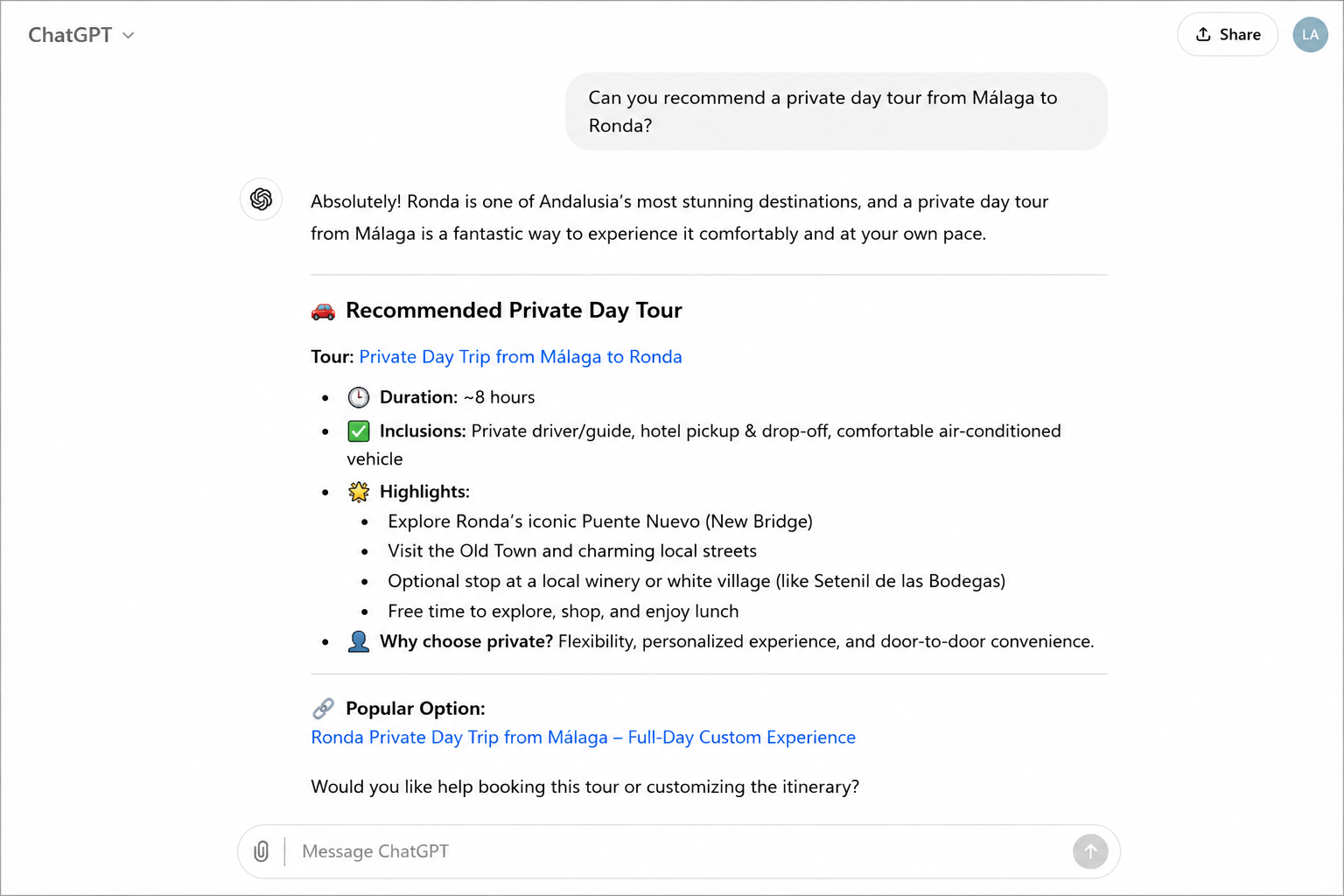
A traveller planning a day trip from Málaga types into ChatGPT: "What's the best private tour from Málaga to Ronda?" The AI gives them three or four specific recommendations — operator names, brief descriptions, a sense of pricing. One of those names might be yours. Probably, right now, it isn't.
That's the new game. And most tour operators haven't realised it's already started.
Why AI Tools Now Matter for Tour Bookings
ChatGPT, Gemini, and Perplexity have become research tools for travellers — particularly higher-spending, independent travellers who are exactly the market private tour operators want. These aren't people scrolling TripAdvisor listings. They're asking a question and trusting the answer they get back.
According to recent data, over 40% of consumers now use AI assistants as part of their travel research process — before they ever visit a booking site. The AI doesn't just point them to Google. It answers. It recommends. It names names.
The operators and small hotels that show up in those answers share specific content characteristics. None of it is mysterious — but it does require deliberate, consistent publishing.
What ChatGPT and Gemini Actually Pull From
AI language models are trained on web content, and they surface recommendations based on what they've indexed from publicly available sources. For tourism, this includes:
Blog posts and destination guides on your own website
FAQ pages with clearly structured questions and direct answers
Review platform profiles (TripAdvisor, Google Business Profile)
Third-party editorial coverage — local tourism sites, travel blogs, press mentions
Structured data markup (schema) that labels your content for machines
The operators who appear in AI answers aren't necessarily the biggest. They're the ones with the clearest, most specific, most well-structured web presence. A boutique operator running 8-person Ronda day trips with 12 solid destination articles has a better shot than a large company with a thin website and no blog.
The Core Principle: Write for the Question, Not the Keyword
Traditional SEO was about ranking for a search term. AI search is about answering a question. The distinction matters because it changes what you write.
A keyword-focused page might target "Ronda day trip from Málaga." An AI-citation-ready page answers the full question someone might ask: "What's the best way to visit Ronda on a day trip from Málaga — and is a private tour worth it?" That means your page needs to include:
A direct answer in the opening paragraph — no wind-up
Specific details: duration, pickup location, what's included, price range
Comparisons where relevant (private vs group tour, driving vs coach)
A FAQ section that addresses the exact questions travellers type into AI tools
This is precisely how we write content at CostaExcursions.es — the tour site we've been building and ranking for 12 years. Every destination guide is structured to answer the real question, not just target a string of words. That's why pages rank on Google and increasingly surface in AI-generated travel answers.
FAQ Schema: The Shortcut AI Tools Love
If there's one technical change that delivers disproportionate results for tour operators in AI search, it's FAQ schema markup.
Schema markup tells search engines and AI tools exactly what your content is: a question and a direct answer. When your page has five or six properly marked-up FAQs, those question-answer pairs are easy for an AI to extract and cite. Without schema, the AI has to interpret your content. With it, you've done the interpretation for them.
Every post BlogDone delivers includes FAQ schema as standard. Not as an add-on. Built in.
Without schema: AI might reference your site vaguely, or skip it entirely
With schema: Your specific answers get lifted and attributed — sometimes verbatim
For a private tour operator or boutique hotel, being cited in a ChatGPT answer is the equivalent of a TripAdvisor recommendation — except it happens before the traveller has even opened a browser tab.
Topical Authority: Why One Post Isn't Enough
AI models don't just pull from individual pages — they build a picture of your site's authority on a topic. An operator with 15 articles about day trips from the Costa del Sol, each well-structured and internally linked, signals something a single tour page never can: that you actually know this territory.
This is called topical authority, and it's one of the more underestimated levers in both traditional SEO and AI visibility. When an AI tool is deciding between recommending Operator A and Operator B for a Seville day trip from Marbella, it's not just looking at one page. It's reading the pattern across your site.
What that pattern needs to look like:
Destination guides for every key location you operate in
Practical "how-to" content that answers common pre-trip questions
Comparison articles (private tour vs self-drive, for example)
Content that links between related articles — creating a web, not a collection of standalone posts
Most operators have none of this. That's not a criticism — it's just reality. Running tours, managing bookings, and dealing with guests leaves no room for consistent publishing. Which is where done-for-you content comes in.
Want your tour business showing up when travellers ask AI tools for recommendations? BlogDone plans, writes, and publishes the content that builds that visibility — destination guides, FAQs, comparison posts, all with schema markup built in. We do it for our own tour site (CostaExcursions.es) and for independent operators across Spain and beyond. See how Blog Done works — or get in touch for a free sample post written for your destination.
What Small Hotels Can Do Right Now
Hotel owners reading this face a slightly different challenge. AI tools often recommend hotels by pulling from review aggregators, their own website, and local editorial content. The same principles apply, but the content types differ:
Location guides: "What to do near [your hotel]" — these perform well in AI answers because they answer a real pre-arrival question
FAQ pages: Check-in times, parking, local restaurant recommendations, beach distances — structured as proper FAQ schema
Comparison content: "[Your area] vs [nearby area] — which is better for a relaxing break?" positions your property in a decision travellers are actively making
Seasonal guides: "Best time to visit [your destination]" is a question AI tools answer constantly — your site should be a cited source
A boutique hotel in Nerja with a well-maintained blog covering the local area, the beaches, and what to do in the White Villages will beat a larger hotel with a thin website every time — in Google search and in ChatGPT answers.
The Uncomfortable Truth About AI Visibility
Here it is: the operators and small hotels that will dominate AI recommendations over the next two to three years are the ones publishing consistently right now. Not perfectly. Consistently.
AI models are trained on web data. The more authoritative, specific, and structured your content is — and the earlier it exists — the deeper it embeds in what those models understand about your destination, your tour type, and your niche. Operators who wait until AI search "matures" will find the positions are already taken.
You don't need 50 articles overnight. You need a plan and a reliable way to execute it month after month.
[ADD IMAGE: Diagram showing content → schema → AI citation pipeline | alt: "How tour operator blog content gets cited by AI tools like ChatGPT and Gemini"]
Frequently Asked Questions
How does ChatGPT decide which tour operators to recommend?
ChatGPT and similar AI tools draw on web content indexed during their training and, in some versions, real-time search results. Operators with well-structured websites, detailed destination guides, FAQ schema markup, and consistent publishing tend to appear more frequently. Review platform presence (TripAdvisor, Google Business Profile) also contributes to AI visibility.
Is SEO still relevant if travellers are using AI instead of Google?
Yes — and the two are more connected than they appear. AI tools like Gemini are built on Google's index, and ChatGPT's browsing features pull from search results. Strong SEO content that ranks on Google tends to surface in AI answers too. The skills overlap significantly: clear structure, specific answers, schema markup, and consistent publishing serve both.
What type of content is most likely to get cited by AI tools?
Content that answers specific questions directly tends to perform best. Destination guides with a clear structure, FAQ sections with schema markup, comparison articles, and practical "how-to" content are all formats that AI models extract and cite efficiently. Vague, thin, or promotional-only content is rarely cited.
How many blog posts does a tour operator need to build AI visibility?
There's no fixed number, but topical authority — the pattern of coverage across your site — matters more than any single post. An operator covering 10–15 destinations and tour types with well-structured articles will build meaningful AI visibility faster than one with 50 thin pages. Quality and internal linking structure matter as much as volume.
Does FAQ schema markup really make a difference for AI recommendations?
It does. FAQ schema explicitly labels question-and-answer pairs so AI systems can extract them without interpretation. Pages with proper FAQ schema have a structural advantage over unstructured content — the AI knows exactly what the question is and exactly what the answer is. For tour operators, this means your specific details (pricing, inclusions, pickup logistics) are more likely to be cited accurately.
Can a small hotel benefit from AI-optimised content, or is this mainly for tour operators?
Both benefit, though the content types differ. A boutique hotel gains the most from local area guides, FAQs about the property and destination, and seasonal content that answers pre-trip planning questions. AI tools frequently surface hotels when answering questions like "where should I stay near [destination]" — structured, location-rich content increases the chance of being cited in those answers.