Case Study: How One Tour Operator Went From 100% OTA-Dependent to Just 30%

Most claims about content and SEO in the travel industry are theory. This one isn't. CostaExcursions.es, the private day tour company behind BlogDone, used to depend on OTAs for 100% of its bookings. Today, Viator, GetYourGuide, and similar platforms account for roughly 30% of revenue. The other 70% books direct.
This didn't happen through a marketing trick or a lucky viral moment. It happened through a specific, repeatable content strategy — the same one we now run for other tour operators, hotels, and vacation rental owners through BlogDone. Here's exactly what changed, in order.
The Starting Point: 100% OTA-Dependent
Like most independent tour operators, CostaExcursions started entirely reliant on third-party platforms for bookings. Every reservation meant handing over 25–30% of the revenue to a platform that owned the customer relationship, not the operator. The website existed, but it wasn't doing any of the work of actually bringing in direct traffic.
Step One: Fixing Cluster Cannibalization
The first real gain didn't come from publishing more content. It came from noticing that multiple pages on the site were competing against each other for the same search — three or four articles all targeting "things to do in Ronda," none of them winning because Google couldn't identify which one was the authority.
Every existing page was mapped by destination and target keyword
Competing pages were merged into one stronger page, with redirects consolidating the rest
One pillar page per destination replaced several overlapping, weaker ones
On this specific rebuild — the Ronda cluster — direct bookings for that destination went from 22% to 67%. That was the first concrete proof the approach worked, not just in theory.
Step Two: Replacing Adjectives With Facts
The second shift mattered just as much, though it was less immediately visible. Early content read like most tour company websites: "unforgettable," "world-class," "hidden gem." None of that tells a traveler — or a search engine — anything specific enough to act on.
Vague descriptors were replaced with exact tour durations, prices, and pickup points
Honest notes were added on who a tour isn't a good fit for, rather than presenting every experience as universally ideal
Content was restructured around the specific decision a traveler was trying to make, not the destination in the abstract
This is a slower process than publishing high volumes of generic content. It's also the only version that actually converts, because it answers a real question instead of describing a mood.
This is the exact process behind CostaExcursions' own numbers — and the same one we run for BlogDone clients. Get your free sample article → — tell us your destination or niche and we'll write one real post built to this standard, at no cost, so you can see it applied to your own business first.
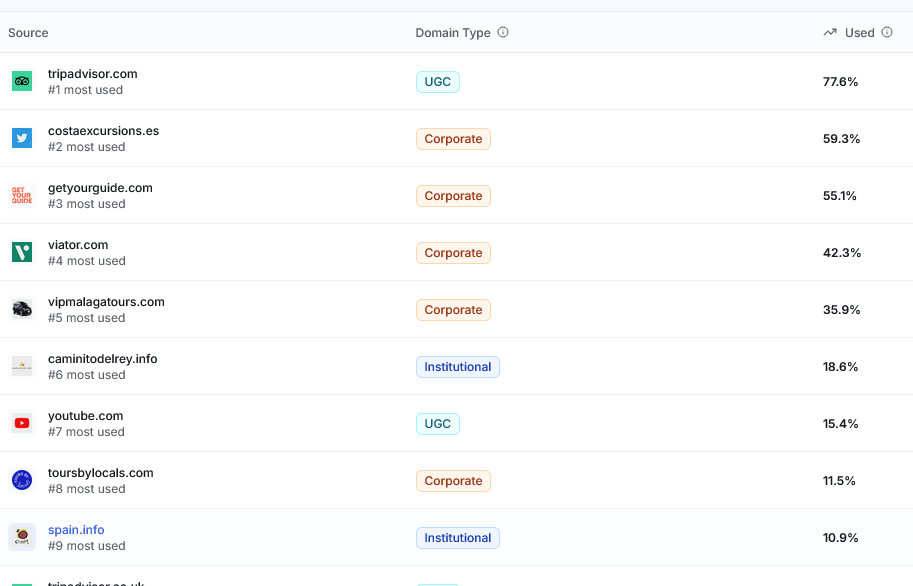
The Unexpected Second Payoff: AI Visibility
Neither of these changes was originally made with AI assistants in mind — cannibalization fixes and fact-based writing predate ChatGPT becoming a mainstream travel-planning tool. But the same standard that fixed direct bookings turned out to be exactly what makes a business quotable to an AI model today.
Vague marketing copy gives an AI assistant nothing to extract and repeat with confidence. Specific facts, one clear page per topic, and an FAQ section with schema markup give it exactly what it needs to recommend a business by name. The content built to solve an OTA-dependency problem became, without any additional rework, the content structure that supports AI-visibility today.
What the Numbers Actually Show
Overall OTA dependency: from 100% to approximately 30% of revenue
Ronda destination cluster specifically: direct bookings from 22% to 67% following the cluster rebuild
Underlying method: cannibalization fix first, then fact-based rewriting — not increased publishing volume alone
None of this happened in a single month. It's the result of a sustained, specific process applied consistently over time — which is also why it's repeatable for another business willing to apply the same standard.
What This Means If You're Still Mostly OTA-Dependent
The starting point for CostaExcursions was 100% — the same starting point most independent tour operators, hotels, and vacation rental owners are at today. The path from there isn't a secret formula. It's a specific, checkable process: fix what's competing with itself first, then replace vague content with real, checkable facts.
Frequently Asked Questions
How long did it take to go from 100% OTA-dependent to 30%?
This was a sustained process over several years, not a single campaign. The Ronda cluster rebuild specifically — one part of the broader strategy — showed direct bookings for that destination moving from 22% to 67% following the rebuild.
What was the single change that made the biggest difference?
Fixing cluster cannibalization — merging pages that were competing against each other for the same search into one clear, authoritative page — produced the first measurable gain. Replacing vague marketing language with specific facts compounded that gain over time.
Is this specific to tour operators, or does it apply to hotels and vacation rentals too?
The underlying method applies across travel niches. Hotels compete with Booking.com and Expedia, vacation rentals and B&Bs compete with Airbnb, and tour operators compete with Viator and GetYourGuide — but in every case, fixing cannibalization and replacing vague copy with specific facts is the same repeatable process.
Did this strategy require a large content team or budget?
No — it was built and run as a single-operator effort, which is exactly why it's structured as a productized, done-for-you service now: it's designed to work for small, independent travel businesses without requiring an in-house content team.
Was AI visibility part of the original goal?
No — the original goal was purely reducing OTA commission dependency through direct bookings. AI visibility turned out to be a second payoff from the same content standard, since the specificity and structure that convert human visitors are also what AI assistants need to recommend a business with confidence.
Want to see what this looks like applied to your own business? Get your free sample article → — no cost, no commitment, just one real post built to the same standard behind these numbers.